
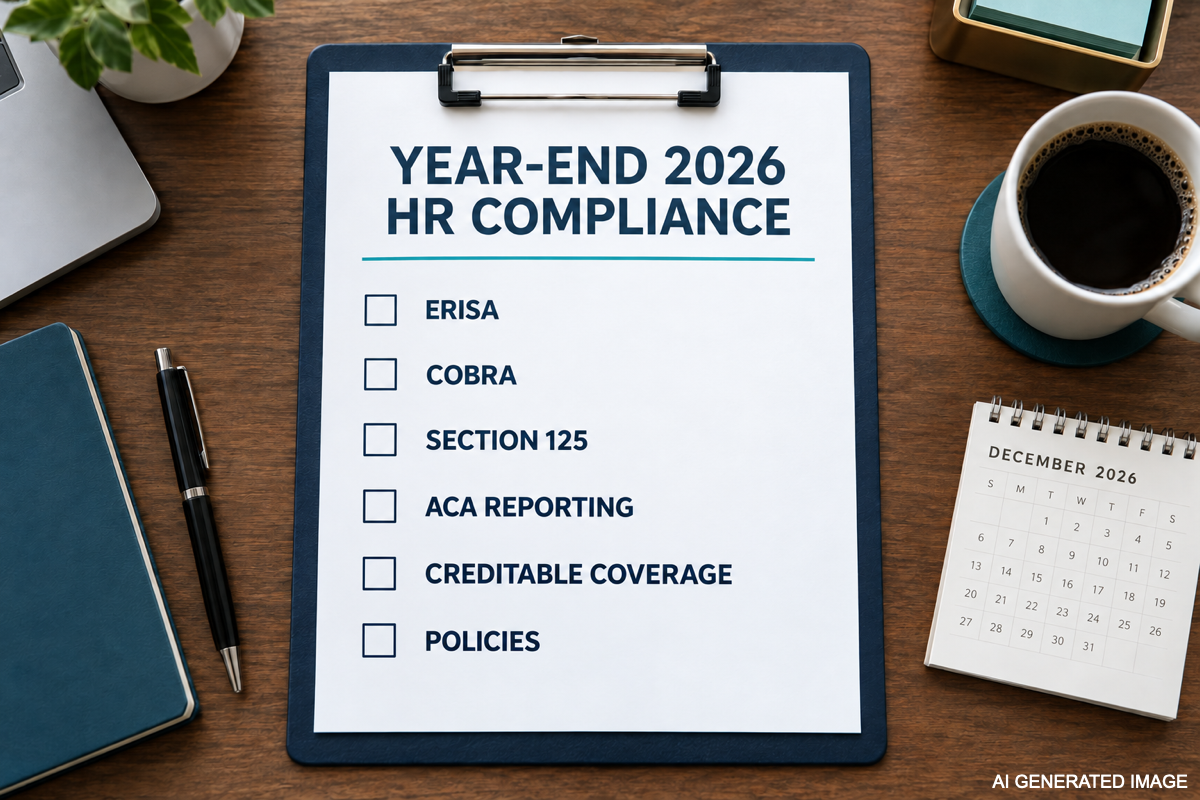

End-of-Year HR Compliance Checklist: What Your Business Needs to Wrap Up

October 16, 2026

Essential Compliance Responsibilities to Finalize Before the Close of 2026


As 2026 comes to a close, HR and benefits administrators face more than holiday planning and budget forecasting. Year-end compliance responsibilities are critical to avoid penalties, ensure smooth operations, and set your business up for a successful new year.


It can be daunting, but we're here to help, and the practical checklist below is a great place to start. Tackle one section at a time, and reach out to us if you get stuck. We'll go over ERISA, COBRA, Section 125, ACA reporting, creditable coverage notices, and handbook updates.


ERISA Plan Year-End Tasks


If your company offers health, dental, vision, life or disability benefits, you're likely subject to the Employee Retirement Income Security Act (ERISA). Before year-end, verify the following:


Wrap Plan Documents and Summary Plan Descriptions


Ensure your plan documents and wrap documents are current. If your plan has changed during the year, you need to update your Summary Plan Description (SPD) to reflect those changes. That can include coverage levels, eligibility rules, or benefits. An outdated SPD creates a compliance risk and can confuse employees about what's actually covered.


Verify Form 5500 Filings


If you filed a Form 5500 extension earlier in the year, your extended deadline is October 15, 2026. This requirement applies to employers with 100 or more participants in self-insured or ERISA-covered plans. Small welfare plans (fewer than 100 covered participants) that are fully insured or unfunded are generally exempt from this filing requirement.


Missing the Form 5500 deadline can result in significant Department of Labor penalties—up to $2,739 per day of noncompliance. Take a moment to verify that you filed or make arrangements to do so.


Finalize Plan Year Closeout Documentation


Complete all compliance documentation for plan-year reporting and maintain it in your ERISA file for audit protection. This includes testing results, nondiscrimination certifications, and any amendments made during the year.


Issue COBRA Notices


COBRA (the Consolidated Omnibus Budget Reconciliation Act) requires employers with 20 or more employees to offer continuation of health coverage after qualifying events such as termination of employment or reduction in hours. Each year, you need to communicate next year's rates to employees by November.


Conduct a COBRA Audit


Review all required notices to ensure they've been issued properly and within required timelines. If you missed a deadline, address it now before an employee files a complaint. Verify that notices are being sent on time, that premium billing is accurate, and that records are in order.


Update COBRA Rates for 2027


COBRA premiums for the next calendar year should be calculated and communicated to participants by November. Determine your plan's 102 percent rate (the COBRA premium cap) and ensure notices are distributed to covered beneficiaries.


Review Section 125 (Cafeteria Plan) Compliance


Section 125 plans allow employees to pay for benefits using pre-tax dollars. If benefits or eligibility rules have changed during the year, your plan document and summary must reflect those changes. This includes changes to FSA limits, dependent care FSA availability, or any shift in benefit offerings.


Conduct Nondiscrimination Testing


Highly compensated employees should not receive a disproportionate benefit under your pre-tax plans. Conduct nondiscrimination testing now to ensure compliance, particularly if any plan design changes were made during the year.


Clarify Carryover and Grace Period Rules


For health care and dependent care FSAs, determine your approach to unused balances. You can offer carryover (up to $680 in 2026), a grace period (up to 2.5 months into the following plan year), or a runout period. Communicate your policy clearly to employees so they understand how to use remaining FSA balances before year end.


Confirm ACA Reporting Requirements


Under the Affordable Care Act, Applicable Large Employers (ALEs), or those with 50 or more full-time or full-time equivalent employees, face specific reporting obligations.


Gather Data for Forms 1094-C and 1095-C


You must file Forms 1094-C and 1095-C with the IRS and distribute 1095-C forms to all full-time employees who had coverage during 2026. Verify that your payroll or benefits platform can accurately track full-time status, hours of service, and plan affordability.


Understand 2027 Filing Deadlines


For the 2026 calendar year:


  • Distribute 1095-C forms to employees by March 2, 2027
  • E-file Forms 1094-C and 1095-C with the IRS by March 31, 2027 (March 2 if filing paper returns, though most ALEs must file electronically)


Start gathering data now so you're not scrambling in the first quarter.


Track Full-Time Status Accurately


Ensure your records clearly show which employees were full-time for each month in 2026. The ACA's definition of "full-time" is 30+ hours per week. Misclassification is one of the most common ACA reporting errors.


Confirm Affordability Thresholds


The 2026 affordability rate is 9.96 percent of household income (up from 9.02 percent in 2025). Use this threshold when evaluating whether your lowest-cost self-only health plan meets affordability requirements.


Distribute Creditable Coverage Notices


If your business offers a group health plan that includes prescription drug coverage—whether fully insured or self-funded—you must notify Medicare-eligible individuals each year whether your coverage is creditable or non-creditable under Medicare Part D guidelines.


Understand Creditable vs. Non-Creditable Coverage


"Creditable coverage" means your plan's prescription drug benefits are expected to pay at least as much, on average, as standard Medicare Part D. If your plan does not meet this standard, it's classified as non-creditable. This distinction matters because Medicare-eligible individuals may face late-enrollment penalties if they delay signing up for Part D without having creditable coverage in place.


Identify All Required Recipients


You must provide this notice to anyone eligible for your plan's prescription drug coverage, whether or not they're currently enrolled. This includes:


  • Active employees
  • COBRA beneficiaries
  • Covered spouses and dependents
  • Any Medicare-eligible individual eligible for coverage under your plan


Do not assume someone is not Medicare-eligible based on age or employment status. When in doubt, issue the notice.


Meet Annual Deadline


The Creditable Coverage Notice must be provided annually before October 15.


Additional timing requirements include:


  • Before an individual's initial Medicare Part D enrollment
  • Before coverage begins for new hires or newly eligible individuals
  • Within 30 days of any change in your plan's creditable status
  • Upon request from a plan participant


File With CMS


In addition to notifying participants, you must report your plan's creditable coverage status to the Centers for Medicare & Medicaid Services (CMS) annually. Submission must occur:


  • No later than 60 days after the start of your plan year
  • Within 30 days of any change in status
  • Upon termination of the plan


This filing is completed electronically through the CMS Creditable Coverage Disclosure Portal. Failure to submit on time can result in penalties.


Update Employee Handbooks and Policies


The end of the year is an ideal opportunity to review and refresh your employment policies.


Review for State and Local Law Changes


Employment law is constantly evolving. Review your handbook and policies for compliance with updated state or local laws, including minimum wage requirements, paid leave mandates, harassment prevention policies, and any new local employment rules that took effect during 2026.


Update Schedules and Policies


Refresh holiday schedules, paid time off policies, benefits summaries, and any procedures that changed during the year. Inconsistencies between your handbook and actual practice create compliance risk and employee confusion.


Incorporate New Requirements


Depending on your jurisdiction, ensure your handbook addresses emerging topics such as remote work guidelines, artificial intelligence use disclosures, pregnancy accommodation policies, or any other regulatory changes affecting your workforce.


Looking Forward


Year-end HR compliance is essential to keeping your business legally sound and your employees protected. Close out the year properly to prevent headaches, fines, and missed deadlines in the months ahead.


As you work through the checklist above, if you have questions about any of these requirements, reach out to us. We can help you navigate the details specific to your situation and industry.

Woman in a black top holding a pink ribbon and smiling against a gray background
October 7, 2026
Breast Cancer Awareness Month is a reminder to know your normal, discuss screening with your doctor, and understand how your health coverage supports cancer care.

Stressed person at a desk rubbing their eyes beside a laptop and white lamp
September 30, 2026
Learn how environmental factors affect employee vision, what you can do to improve your workplace, and why vision insurance matters for retention and morale.

Three people reviewing a document at a table in a bright office, with coffee and a tablet nearby.
September 25, 2026
Online calculators are only a starting point. Here is a simple four-part way to think through how much life insurance fits your family and your budget.

Business meeting in a glass office, with people seated at tables while a presenter speaks by the wall.
September 23, 2026
Most employees don't understand their benefits, and it's costing employers money. Learn practical ways to improve health care literacy at your organization.

Hands typing on a laptop keyboard at a desk, with a blurred notebook in the background
September 16, 2026
Employers who offer drug coverage must send Medicare Part D creditable coverage notices before October 15. Learn who must comply and what changed for 2026.

Assorted snack chips and soda displayed on a grocery store shelf, with empty spaces between products
July 16, 2026
A landmark study found that people eating ultra-processed foods consumed more calories and gained weight. Learn why and how to make healthier choices.

Person working on a laptop at a desk with a notebook and monitor in a bright office
July 6, 2026
The PCORI fee is due July 31 on IRS Form 720. Find out which employers owe it, the 2026 rate, how to calculate covered lives, and how to file on time

Two sparklers crossing, spraying bright white sparks against an orange background
June 29, 2026
Learn simple Fourth of July safety tips to help prevent injuries, fires, and accidents while enjoying fireworks and holiday celebrations. 

Close-up of assorted colorful aluminum can tops with pull tabs, tightly packed together
By Agency Bloc • July 1, 2025
As the summer sun beckons and thirst levels rise, it's tempting to reach for a cold, fizzy beverage. But before you pop open that soda can, consider this: your drink choice has long-term implications for your health. The Hidden Risks in Your Glass A comprehensive study by the International Agency for Research on Cancer (IARC) analyzed data from over 451,000 individuals across 10 European countries over a 16-year period. The findings revealed that consuming two or more 250 ml glasses of soft drinks daily—whether sugar-sweetened or artificially sweetened—was associated with a higher risk of all-cause mortality compared to those who drank less than one glass per month. Delving deeper: Artificially Sweetened Beverages : Individuals consuming two or more glasses daily had a 26% higher risk of death compared to those who consumed less than one glass per month. Specifically, there was a 52% increased risk of death from circulatory diseases. Sugar-Sweetened Beverages : Those consuming one or more glasses daily faced a 59% higher risk of death from digestive diseases. All Soft Drinks : A notable association was found between soft drink consumption and increased mortality from Parkinson's disease. Alternatives That Aren’t Any Healthier Think fruit juice or energy drinks are a safer bet? A study involving 13,440 U.S. adults aged 45 and older found that each additional 12-ounce serving of sugary beverages, including 100% fruit juice, was linked to an 11% higher risk of all-cause mortality. Specifically, each additional 12-ounce serving of fruit juice was associated with a 24% increased risk. Watch the sugar content of iced coffee beverages and alcoholic cocktails as well. Lifestyle Factors Matter, Too It's essential to note that high soft drink consumption often correlates with other unhealthy lifestyle choices. The IARC study observed that individuals who drank more soft drinks typically had higher body mass indexes and were more likely to smoke. Even after adjusting for factors like diet, physical activity, smoking, and education, the association between soft drink consumption and increased mortality risk remained significant. Refreshing Alternatives for the Season Looking to quench your thirst without compromising your health? Here are some delightful, healthier options: Infused Water : Add slices of citrus fruits, cucumbers, or berries to your water for a refreshing twist. Herbal Iced Teas : Brew teas like hibiscus or mint, chill them, and enjoy over ice. Sparkling Water with a Splash : Mix sparkling water with a splash of 100% fruit juice for a fizzy treat. Homemade Lemonade : Use fresh lemons, water, and a touch of natural sweetener like honey or stevia. Coconut Water : A natural source of electrolytes, perfect for rehydration. Final Thoughts Summer is a time for relaxation and enjoyment. By making informed beverage choices, you can savor the season while prioritizing your health. So, the next time you're reaching for a drink to beat the heat, consider these healthier alternatives. Your body will thank you!

Person holding a large map in front of a white car in a dry desert landscape
By Agency Bloc • July 1, 2025
Whether you’re planning a weekend getaway or a long-awaited international adventure, setting off on a trip is always exciting—but can also be unpredictable. That’s why preparing for the unexpected, especially when it comes to your health, is essential. Knowing what your medical coverage includes (and doesn’t) while traveling can help you stay healthy, avoid costly surprises, and soak up the unforgettable moments on your journey. Let’s walk through some proactive steps you can take before packing your bags—from vaccinations and insurance to emergency planning and fraud protection. 1. Know What Your Health Plan Covers—And Where Medical surprises aren’t on anyone’s itinerary—but it’s best to be prepared. Start by knowing how your insurance policy covers (or doesn’t) the region you’re traveling to. Individual health policyholders, review your insurer’s network coverage. Some plans only cover in-network or state-specific services, while others offer broader emergency coverage or travel-specific riders. Consult your insurance agent to get help reviewing your policy. Medicare beneficiaries, Original Medicare (Parts A & B) typically doesn’t cover medical care outside the U.S., except in limited circumstances. If you have a Medicare Advantage Plan, it may include emergency and urgent coverage abroad, but this varies by provider. Check your plan’s Evidence of Coverage or speak to your plan representative before traveling. 2. Consider Supplemental Insurance If you're a frequent traveler or heading abroad, look into some options to help cover you. Some options include: Travel Medical Insurance : Plans offer emergency coverage during trips outside the U.S. and tend to be affordable. Evacuation Insurance : This covers transport to a qualified medical facility if the nearest care is inadequate. An evacuation clause is often, but not always, included in a travel insurance plan. Medicare Supplement Insurance (Medigap) : Some Medigap policies cover emergency care abroad, typically up to plan limits and with a deductible. Critical Illness Insurance : A lump-sum payout can provide financial flexibility in case you’re diagnosed with a covered condition like a heart attack or stroke during travel. Be sure to read the fine print—some policies require you to be under a certain age, and preexisting conditions may not be covered. Your licensed insurance agent can help talk you through your options. 3. Keep Your Medical Info Handy Consider using a secure health app or digital wallet to access all your health records quickly. But just in case your phone is inaccessible, bring physical copies of these important documents as well:  Your insurance or Medicare cards Emergency contact numbers (include the country code +1 if you’re traveling abroad) A medication list with dosages Allergy and medical condition alerts Pack all essential paperwork together in a waterproof sleeve in your luggage, and leave a second copy with someone back home. 4. Schedule Preventive Care Before Departure Most insurance plans cover preventive care services like wellness visits, vaccinations, and screenings. Before your trip, check these tasks off your list: Get vaccinated : Make sure you’re up to date on your flu, COVID-19, and tetanus shots. If traveling internationally, check the CDC recommendations for the region you’re visiting, which may include Hepatitis A/B, typhoid, or yellow fever vaccinations.
Show More